
Jack Vettriano is one of Scotland’s most celebrated and controversial contemporary artists. Born Jack Hoggan in 1951 in the coastal town of Methil, Fife, he grew up in a working-class family and left school at 16 to become an apprentice mining engineer. Little did anyone know that this young man from humble beginnings would one day become a globally recognized artist, known for his evocative and cinematic paintings.
A Self-Taught Journey
Vettriano’s journey into the art world was unconventional. He did not receive formal art training but instead taught himself to paint by copying works from art books and experimenting with styles. It wasn’t until his girlfriend bought him a set of watercolours for his 21st birthday that his passion for painting truly ignited. He initially signed his paintings as “Jack Hoggan” but later adopted his mother’s maiden name, Vettriano, when he decided to pursue art more seriously.
His breakthrough came in 1989 when he submitted two paintings to the Royal Scottish Academy’s annual exhibition. To his surprise, both sold on the first day. The following year, he exhibited at the Royal Academy Summer Exhibition in London, where his works were again met with great success. From there, Vettriano’s reputation grew rapidly, and his paintings became highly sought after.
The Allure of His Style
Vettriano’s art is instantly recognizable for its evocative scenes and distinct style. His paintings often depict elegantly dressed men and women in romantic, sometimes provocative, settings. The works exude a sense of nostalgia and glamour, reminiscent of film noir or classic Hollywood cinematography. There’s a sense of drama and intrigue in his compositions, with themes of love, longing, and seduction woven throughout.
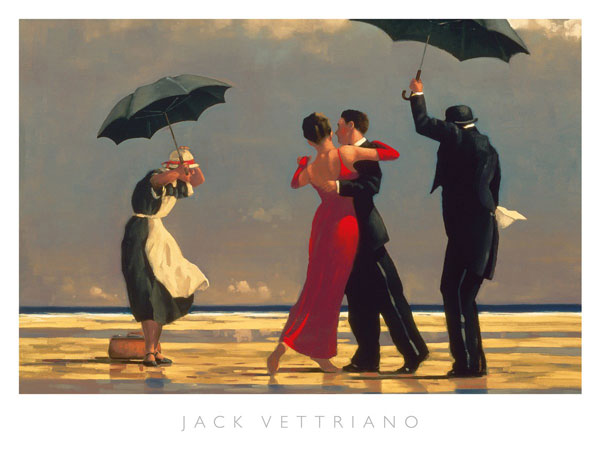
One of his most iconic paintings, The Singing Butler (1992), features a glamorous couple dancing on a windswept beach, attended by a maid and a butler holding umbrellas against the rain. The image captures Vettriano’s signature blend of romance and mystery, set against a backdrop of elegance and charm. The Singing Butler became one of the best-selling art prints of all time, solidifying Vettriano’s status as a household name.
Critical Controversies
Despite his commercial success, Vettriano has often been dismissed by the art establishment. Critics have labeled his work as “kitsch” or overly sentimental, and many galleries have been reluctant to feature his paintings. The art elite’s reluctance to embrace him has sparked debates about the divide between high art and popular appeal.
However, Vettriano’s popularity with the public cannot be denied. His paintings resonate with those who appreciate their storytelling and relatable themes. While critics may dismiss his technical approach as simplistic or derivative, his undeniable ability to capture human emotion and atmosphere has earned him a devoted following.
International Recognition
Although he faced criticism in his native Scotland, Vettriano’s work found a strong following internationally. His exhibitions have drawn crowds from London to New York, and his paintings have fetched high prices at auction. In 2004, The Singing Butler sold for a staggering £744,800 at Sotheby’s in Edinburgh, making it one of the most expensive Scottish paintings ever sold.
Vettriano’s appeal lies in his ability to transport viewers into a world of intrigue and passion. His works tell stories of love, betrayal, and fleeting moments of intimacy, often set against the backdrop of the mid-20th century. The vivid use of colour and composition enhances the seductive quality of his paintings, drawing the viewer into the narrative.
Legacy and Lasting Impact
Vettriano remains a divisive figure in the art world. Some critics still dismiss his work as mass-produced and lacking depth, while others praise his undeniable talent for capturing mood and emotion. Despite the ongoing debate, his influence is undeniable.
Today, Vettriano’s paintings are featured in private collections worldwide, and his prints continue to sell in vast numbers. Though he may never receive unanimous critical acclaim, his impact on contemporary Scottish art is significant. His journey from a self-taught artist to an internationally renowned painter is a testament to his perseverance and dedication to his craft.
Conclusion
Jack Vettriano’s story is one of passion and resilience, proving that talent and dedication can triumph over critical skepticism. His evocative and cinematic style captures moments of romance and mystery that continue to captivate audiences around the globe. Whether celebrated or critiqued, Vettriano’s legacy as one of Scotland’s most beloved and recognizable artists remains secure, and his paintings will undoubtedly continue to enchant future generations.